
Walk into any shipyard in Tuas, any construction site at Marina Bay, or any logistics warehouse in Jurong, and you’ll see operations that took years to refine. Equipment specified down to the millimetre. Safety processes documented in detail. Vendor relationships built over decades.
Then look at the same company’s website.
In most cases, you’ll find a site that doesn’t match the operation. Stock photos that could be from any country. Service descriptions copied from a competitor’s site five years ago. A layout that worked on Internet Explorer 9 and hasn’t been touched since. No clear way for a prospective client, recruit, or partner to understand what the company actually does.
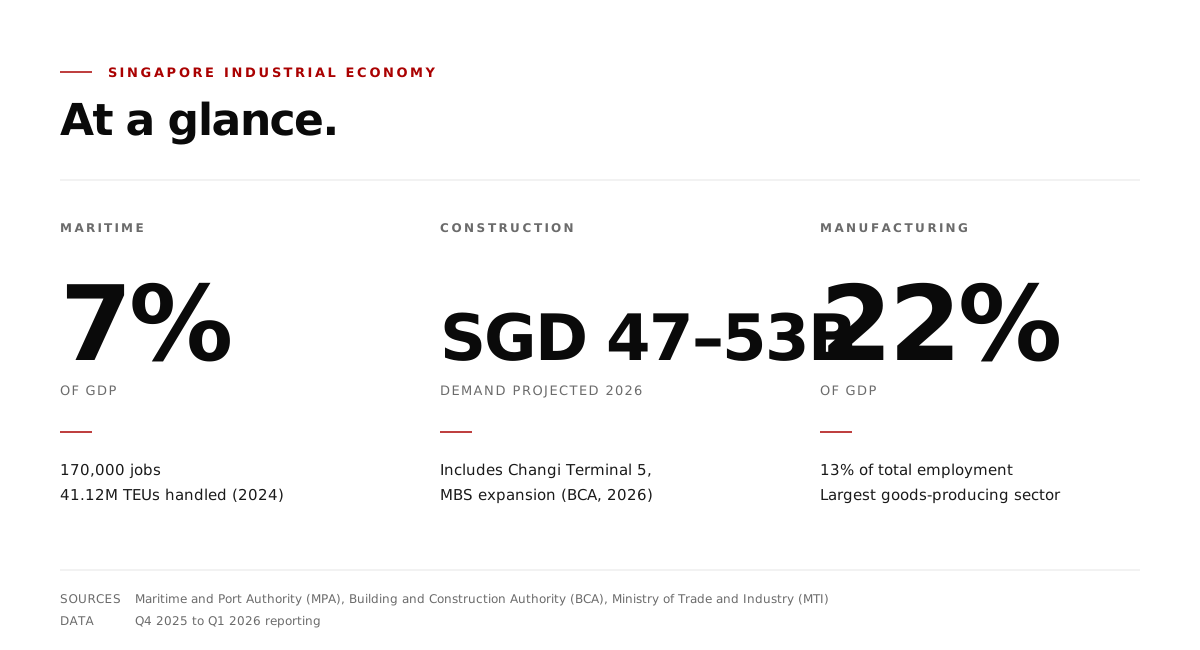
This is not a small problem. Industrial companies in Singapore compete in some of the most demanding sectors in the world. The maritime industry contributes around 7% of GDP and employs roughly 170,000 people, with Singapore’s ports handling a record 41.12 million TEUs in 2024. Construction demand for 2026 is projected at SGD 47 to 53 billion (around USD 36 to 40 billion) by the Building and Construction Authority. Manufacturing accounts for around 22% of GDP and 13% of total employment. And yet the digital presence of most companies in these sectors lags five to ten years behind their operational sophistication.
This piece is about why that matters, what an industrial company website actually needs to do, and how to think about commissioning a partner who can build one.
The state of industrial websites in Singapore.
Generic agencies and template shops have done well in Singapore. The country has thousands of web design providers offering “professional websites” at every price point. For cafes, boutique retailers, e-commerce stores, and small consumer businesses, this works fine. A template gets you online. A logo makes you look legitimate.
For industrial companies, this approach quietly fails.
The reason is that industrial buyers, partners, and recruits evaluate websites differently. A marine engineering MD looking at a potential subcontractor isn’t asking “does this look pretty?” They’re asking: how long have they been operating, what’s the scope of their capability, who have they worked with, do they understand my technical requirements, and can I trust them with a project that has real safety and commercial consequences if it fails.
A template website cannot answer these questions credibly. The same layout used by a yoga studio cannot communicate decades of engineering experience. Stock photos of generic factory workers cannot convey actual technical depth.
What we see across industrial websites in Singapore tends to fall into four recurring patterns.
The brochure that aged out. Built five to ten years ago. Still working technically. Reads like a small business pamphlet, not a serious operation. Often has a Flash element that no longer loads or a “News” page last updated in 2018.
The template that doesn’t fit. A newer site built on a generic WordPress or Wix template. Looks fine at first glance. On closer inspection, the structure is built for retail or services, not for showcasing technical capability, certifications, project portfolios, or vendor credentials.
The over-designed marketing site. Beautiful agency-built site that prioritises visual flair over actual information density. Looks great on Behance. Doesn’t help a procurement officer find what they need in 30 seconds.
The DIY effort. Built by someone internal who knows just enough to deploy a site. Usually has the right intent but wrong execution. Missing critical pages, broken contact forms, unclear navigation, no mobile consideration.
The pattern across all four is the same. The website is not doing meaningful work for the business. It exists because companies are supposed to have a website. It is not winning deals, attracting talent, or signalling credibility.
This is fixable. But fixing it requires thinking carefully about what an industrial company website actually needs to do.
What an industrial website actually needs to do.
Forget for a moment everything you’ve heard about modern web design. Strip away the discussion of animations, parallax effects, and visual trends. The honest functional requirements of an industrial company website come down to four things.
One: signal credibility to procurement and partnership audiences.
When a procurement officer at a multinational evaluates a potential vendor, they will visit your website. They want to see operational scale, history, certifications, key personnel, scope of capability, and proof of similar projects delivered. They want this information accessible within 30 seconds. They are not going to dig through a hidden menu structure.
The website’s job in this scenario is to make a yes-or-no signal as fast as possible. Yes, this company looks credible. Or no, this company looks fly-by-night. The signal happens before they even read the content. It comes from the typography, the photography, the structure, the loading speed, and the overall sense of operational seriousness.
Two: serve as a talent acquisition tool.
Industrial sectors in Singapore are facing serious talent challenges. Maritime, construction, and engineering all compete for skilled workers, engineers, and project managers. When a senior candidate considers an employer, they will check the website. A website that looks like it was built in 2012 signals that the company is not investing in its future. A website that looks current signals the opposite.
You don’t need a careers page that lists every open role. You need a website that, in its overall presentation, makes a senior candidate think “this is a serious operation I’d be proud to work for.”
Three: function as a partner-facing artifact.
When you bid for international work, partner with overseas firms, or attend a trade show, your website is often the first thing a potential collaborator looks at. This is especially true for Singapore companies expanding regionally across Southeast Asia or working with European, Japanese, Korean, and US-headquartered groups.
The website needs to translate your local credibility into an internationally legible format. That means clear English, professional photography (not stock), structured information, and a presentation that holds up against websites of similar firms in Norway, Germany, or Houston.
Four: capture inbound enquiries from procurement teams.
This is where most industrial websites lose the most opportunity. A procurement officer evaluating vendors might find your site through a Google search, a referral, or a trade publication. They want to send a request for quotation, ask a specific technical question, or arrange a meeting. The form on most industrial websites either doesn’t work, sends submissions into a generic inbox that nobody monitors, or requires too much information upfront.
A well-designed contact funnel captures the lead, routes it to the right internal owner, and confirms receipt within minutes. None of this is technically hard. Most websites just don’t do it.
These four functions are not unique to industrial companies. But they are particularly weighted for industrial companies, where deals are larger, sales cycles are longer, and credibility signals matter more.
Sector-specific considerations.
The four functions above apply across industrial sectors. But marine, engineering and manufacturing, and construction and logistics each have their own specific considerations.
Marine and offshore.
Singapore’s maritime sector includes some of the most technically complex businesses in the country. Shipyards, offshore engineering firms, marine services, port operations, and maritime support all rely heavily on international clients and supply chains.
For marine companies, the website needs to communicate technical capability fast. Specific vessel classes, classification society approvals (DNV, ABS, LR), drydock and yard specifications, project portfolios with named clients where contractually permitted, and clear regional presence are all critical.
The audience is often international. Norwegian, Korean, Japanese, and Middle Eastern operators may evaluate Singapore vendors from offices halfway around the world. The website must work without explanation. It must signal “serious yard, real capability, professional outfit” to someone who has never visited Singapore.
Aluminium Offshore, a current client of ours, illustrates this. Norwegian parent group, Singapore operations, oil and gas focused. Their website needs to communicate technical depth, parent group context, and Singapore-specific operational scope. It cannot read like a generic engineering site.
Engineering and manufacturing.
Engineering and manufacturing firms in Singapore often serve multinational clients, government projects, and regional partners. The website’s primary work is communicating technical scope (what processes, materials, and specifications you handle), demonstrating completed projects, and surfacing certifications and quality processes.
The biggest mistake we see in this sector is over-explaining. Engineering buyers are sophisticated. They don’t need a paragraph telling them what CNC machining is. They need to see your CNC capability, the materials you work with, the tolerances you hold, and projects you’ve delivered. Trust the audience to know what they’re looking at.
THK Engineering, Towa Marine, and similar firms we’ve worked with operate on this principle. Their websites assume technical fluency in the audience and deliver information directly. No marketing fluff. No filler content. Capability, evidence, contact.
Construction and logistics.
Construction and logistics in Singapore are different again. The market is large, fast-moving, and dominated by relationships. Most major contracts come through tender processes or existing client relationships, not cold inbound leads. Yet the website still does meaningful work.
For construction firms, the website needs to demonstrate project track record with specific named developments, key personnel and their experience, safety record and certifications, and capability for the kind of project the prospect is considering. A residential developer evaluating a fitout contractor wants to see other residential fitouts, not the firm’s commercial portfolio.
For logistics, the priorities shift to network capability (where you can actually move goods to and from), specialisation (cold chain, hazmat, customs brokerage, multi-modal), client examples, and clear contact paths for new account enquiries.
Coast to Coast Network, a Singapore-based freight forwarding alliance we recently rebuilt, is a representative example. Their members operate across multiple countries. The website needed to function as both a member directory and a credibility signal for the alliance brand itself. Two audiences, one site, neither compromised.
How Creatif Work approaches industrial web design.
Most agencies pitching industrial clients in Singapore approach the work the same way they’d approach any other client. They run the same discovery process, propose the same template, and deliver in the same workflow. The end result is a generic website with industrial photography pasted in.
Our approach is different in three specific ways.
First, we work with industrial companies as our core specialism, not a side project.
Most of our recent work has been with marine, offshore, engineering, manufacturing, and logistics firms. We turn down ecommerce, lifestyle, and small-business projects. This isn’t snobbery. It’s focus. The kind of work serious industrial clients need is not the same as the kind of work a boutique cafe needs. We’ve made the commercial decision to be excellent at one and decline the other.
Second, we run a four-phase workflow with senior involvement throughout.
Discussion (discovery and scoping). Design and build (the production phase). Feedback and amendments (unlimited revisions, timeline-aware). Handover (final delivery with 30-day post-launch support included). Every phase is run directly by the founder, not handed off to junior staff. You get senior judgment at every decision point, not just at the first meeting.
Third, we own the full project from strategy through hosting.
We handle brand positioning, identity work, web design, build, hosting, and ongoing maintenance under one roof. You don’t manage multiple vendors. You don’t have a strategist hand off to a designer hand off to a developer hand off to a hosting provider. One partner. One point of accountability. End to end.
The work shows up in our recent projects. The U.S. Center for Dairy Excellence (USDEC’s Singapore innovation hub) is a multi-page B2B content site for an international agricultural body. Coast to Coast Network is a Singapore-based freight forwarding alliance with a custom-coded directory platform built alongside the marketing site. Aluminium Offshore, currently in progress, is a Norwegian-parent oil and gas engineering firm with Singapore operations.
These are not generic web design projects. They require strategic thinking about audience, sector positioning, content architecture, and technical execution. They reward a specialist approach.
Starting a conversation.
If you run an engineering, construction, marine, manufacturing, or logistics business in Singapore and your website is doing less work than your operation deserves, there are two ways to start a conversation with us.
Free 30-minute discovery call. No commitment. We talk about your business, your current website, what’s working and what isn’t, and what a meaningful upgrade would look like. At the end of the call, you have a clearer picture of what’s possible and a sense of whether we’re the right partner. Many prospects use this call to clarify their own thinking, even if they don’t end up working with us. Schedule a call with us.
Free homepage mockup for qualified projects. If we’re a good fit after the discovery call and you have a serious project in the pipeline (typically SGD 2,000 and above), we’ll build a custom homepage mockup for your business before you commit to anything. This shows you exactly what working with us looks like and gives you a tangible artifact to evaluate. Most agencies don’t offer this. We do, because the quality of the mockup tells you more about us than any proposal document could.
We’re not the right fit for everyone. We don’t take on ecommerce projects, lifestyle brands, fast-turnaround small business work, or projects where the scope keeps shifting. If you’re a marine, offshore, engineering, manufacturing, construction, or logistics company that wants a website worth taking seriously, we’re worth a conversation.
To start, email hi@creatif.work or call +65 8836 4587.
Sources:
- Maritime and Port Authority of Singapore (MPA) for maritime sector stats: https://www.mpa.gov.sg/
- Building and Construction Authority (BCA) for construction sector stats: https://www1.bca.gov.sg/
- Singapore Department of Statistics for manufacturing data: https://www.singstat.gov.sg/
- Ministry of Trade and Industry (MTI) for manufacturing GDP and employment figures: https://www.mti.gov.sg/