Creatif Work
  • Home
  • Services
    • Websites
    • Custom software
    • AI tools
    • Web apps
    • Infrastructure support
    • Brand identity
  • Our Work
  • Blog
Get in touch
Creatif Work
Get in touch
03 · AI tools

Internal tools that use a model to do one narrow job.

  • AI is worth using where a specific, repeated task is being done by somebody who would rather not be doing it, and where being wrong occasionally is survivable. Most problems in a business are neither. This page is about telling the two apart.
The constraint

The evidence is not what the market says it is.

There is more confident claiming about AI than about anything else we are asked for, and very little of it is measured. What has been measured is worth knowing before you spend anything.

Measured slower, felt faster

In a randomised trial, 16 experienced developers took 19% longer on 246 real tasks using early-2025 AI tools, while estimating afterwards that they had been 20% faster. METR, 2025. The perception gap is the finding.

Almost right is the problem

The top frustration reported by developers using AI, cited by 66%, is solutions that are almost right but not quite. Second, at 45.2%, is that debugging AI-written code takes longer. Stack Overflow Developer Survey 2025.

The experienced are the most sceptical

84% of developers use or plan to use AI tools, yet more distrust its accuracy (46%) than trust it (33%), and the most experienced are the most distrustful. Stack Overflow, 2025, more than 49,000 respondents.

Sample

Believed faster. Measured slower.

This is the most useful piece of evidence about AI at work, because it is randomised, it measures outcomes rather than opinions, and it shows the gap between the two directly.

It is not an argument against using AI. It is an argument for measuring whether a given use actually helped, which almost nobody does.
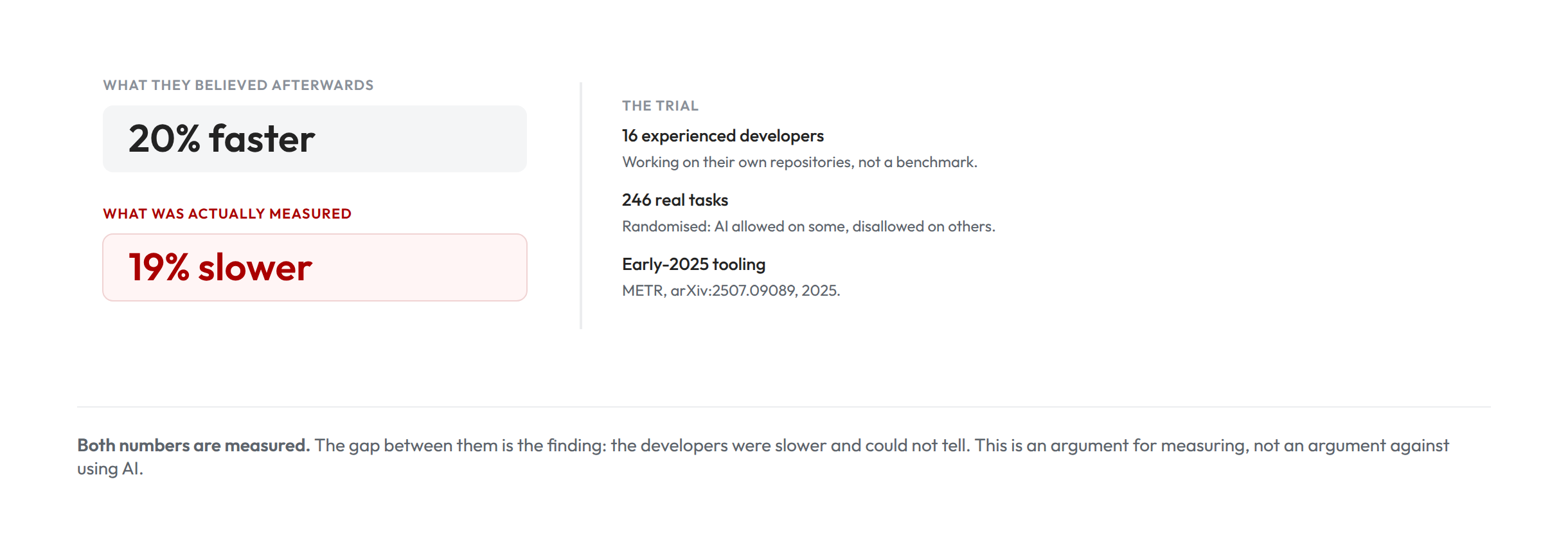
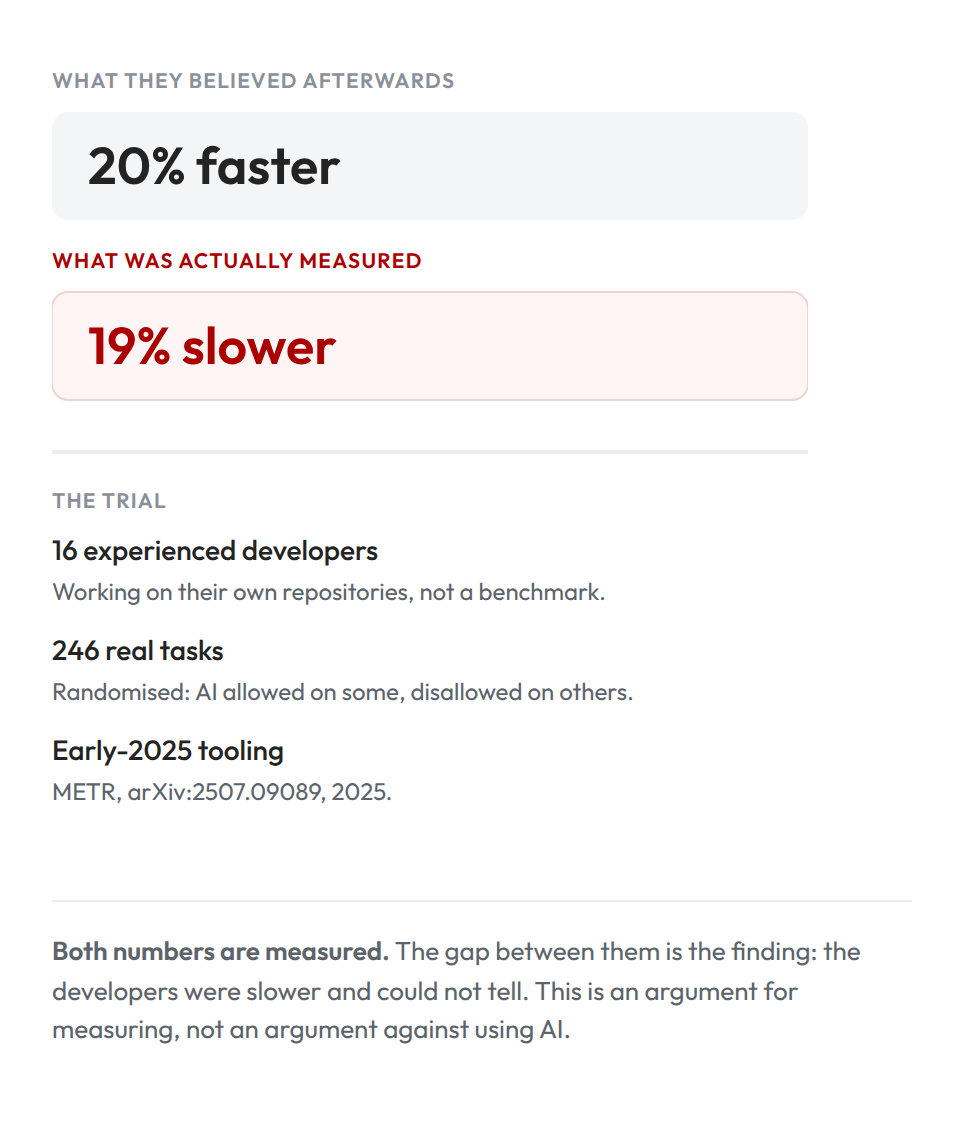
Chart contrasting what developers believed after using AI tools, twenty percent faster, with what the randomised trial measured, nineteen percent slower. METR, 2025, sixteen developers across 246 real tasks.
Vertical version of the chart contrasting a believed twenty percent speed-up with a measured nineteen percent slowdown in METR's 2025 randomised trial.
Fit

When an AI tool is the answer, and when it is not.

The useful question is never whether to use AI. It is whether this particular task has the shape that suits one.

Worth doing when

  • A specific task is repeated many times a week by somebody senior.
  • The input is messy text and the output is a draft a human checks.
  • Being wrong occasionally costs minutes, not money or safety.
  • You can state what working means before anything is built.

Worth postponing when

  • The task happens twice a month.
  • Nobody can say what the tool would do, only that it should use AI.
  • The output goes straight to a client with nobody reading it.
  • The underlying process is broken and the model is being asked to hide it.
Scope

What actually moves the number.

Four things move the cost, and none of them is the model.

Whether a human checks the output
A tool that drafts and a tool that decides are different products at different prices. Drafting is cheap, forgiving, and where most of the real value sits. Deciding requires evaluation, monitoring, an audit trail and a plan for the day it is confidently wrong.
How narrow the job is
One task, one input shape, one output shape is a small build. \u201cHandle enquiries\u201d is not a job, it is a category, and it is where budgets disappear. The narrowing conversation is the most valuable part of the project.
Whether you can tell if it is working
If there is no way to measure whether the tool helped, there is no way to know whether to keep paying for it. Given the METR result, assuming it helped because it feels faster is a documented mistake rather than a shortcut.
Where the data goes
Whether client information can leave your systems changes the shape of the build entirely, and it is a question for you and your clients before it is a technical one.
Questions

What people ask before they commit.

The ones that come up most, answered plainly.

Do we need AI for this at all?
Usually not, and we would rather say so early. A great deal of what is sold as AI is a form, a rule and a notification. Those are cheaper, more predictable and easier to fix. AI earns its place where the input is genuinely messy and a human still reviews the output.
Is this just a wrapper around ChatGPT?
Sometimes that is exactly the right answer, and we will tell you when it is. What you are paying for in that case is the narrowing, the integration into where the work actually happens, and knowing what to do when it is wrong.
What happens when it gets something wrong?
That gets answered before anything is built rather than after. Every tool ships with a defined failure mode: what a wrong answer looks like, who sees it, and what it costs. If we cannot answer that, we do not build it.
Everyone says AI projects fail. Do they?
Gartner predicts more than 40% of agentic AI projects will be cancelled by the end of 2027, and estimates only around 130 of the thousands of agentic AI vendors are real. Treat that as a prediction rather than a measurement, but the direction is consistent with everything else on this page.
Our competitors are already using it.
In Singapore, SME AI adoption tripled from 4.2% to 14.5% in 2024, which IMDA attributes mainly to uptake of off-the-shelf generative tools. Most of that is a subscription rather than a capability. It is a weak reason to spend.
Start here
  • A written answer, not a sales proposal
  • What is wrong, and what to fix first
  • Yours whether or not you build with us

Start with a diagnostic.

Tell us what you're dealing with. You get a written answer: what is wrong, what to fix first, and in what order.

Start with a diagnostic
(+65) 8836 4587

We work out how a business actually runs, then build the thing that's missing.

Get in touch

  • +65 8836 4587
  • hi@creatif.work

Find us

LinkedinGoogle

Start with a diagnostic

Tell us what you are dealing with. You get a written answer either way.

Start with a diagnostic

© 2026 Creatif Work. All rights reserved. UEN 53472293L

  • Terms
  • Privacy
Creatif Work
Manage Cookie Consent
To provide the best experiences, we use technologies like cookies to store and/or access device information. Consenting to these technologies will allow us to process data such as browsing behavior or unique IDs on this site. Not consenting or withdrawing consent, may adversely affect certain features and functions.
Functional Always active
The technical storage or access is strictly necessary for the legitimate purpose of enabling the use of a specific service explicitly requested by the subscriber or user, or for the sole purpose of carrying out the transmission of a communication over an electronic communications network.
Preferences
The technical storage or access is necessary for the legitimate purpose of storing preferences that are not requested by the subscriber or user.
Statistics
The technical storage or access that is used exclusively for statistical purposes. The technical storage or access that is used exclusively for anonymous statistical purposes. Without a subpoena, voluntary compliance on the part of your Internet Service Provider, or additional records from a third party, information stored or retrieved for this purpose alone cannot usually be used to identify you.
Marketing
The technical storage or access is required to create user profiles to send advertising, or to track the user on a website or across several websites for similar marketing purposes.
Manage options Manage services Manage {vendor_count} vendors Read more about these purposes
View preferences
{title} {title} {title}
1

WhatsApp us

Navigation

  • Home
  • Services
    • Websites
    • Custom software
    • AI tools
    • Web apps
    • Infrastructure support
    • Brand identity
  • Our Work
  • Blog
Let's talk

Follow Us

Instagram
Facebook
LinkedIn