
A system that lives in a browser and does real work.
- A web app is not a website with a login bolted on. It is the thing your team, your suppliers or your clients use to get something done, and it is judged on whether the work gets finished, not on how it looks on the first screen.
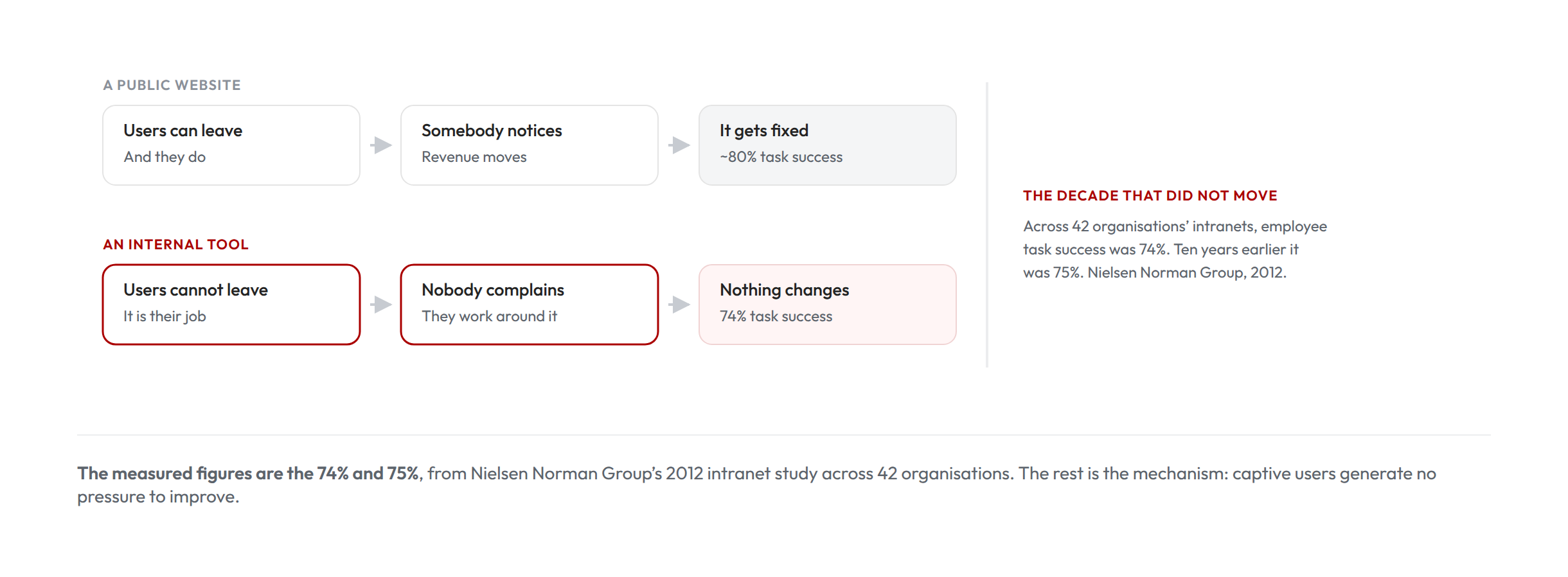
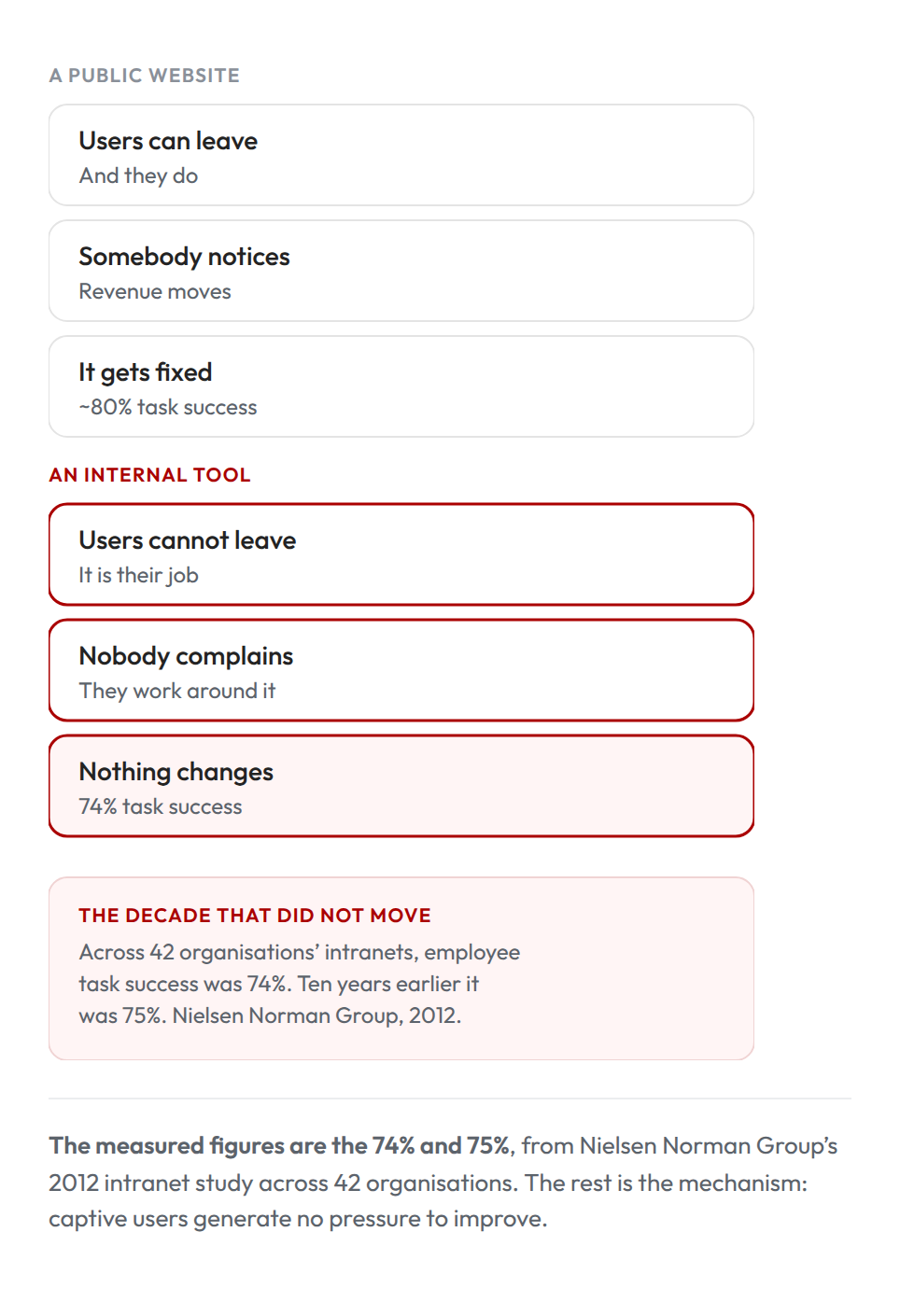
Nobody complains about internal tools. That is the problem.
Internal systems have a captive audience. The people using them cannot go elsewhere, so they work around the problems instead of reporting them, and nothing generates the pressure that makes public-facing software improve.
A decade that did not move
Across 42 organisations’ intranets, employee task success was 74%. Ten years earlier it was 75%, while public websites reached around 80%. Nielsen Norman Group, 2012. The date is the point.
Where the budget already goes
Legacy systems typically consume 70 to 75% of total IT budget and around 80% of total cost of ownership. CISQ, 2022 — an estimate synthesised from 88 sources rather than a measurement, and worth treating as such.
Knowing is not fixing
Even on the flaws organisations worked hardest to patch, only about 54% were fully remediated, at a median of 32 days. Verizon, 2025. A system nobody owns does not get looked after by default.
Why the internal one never gets better.
The mechanism is not laziness and it is not budget. It is that the feedback loop which fixes a public website does not exist inside a business.
When a web app is the answer, and when it is not.
The test is whether somebody is currently doing work the system will not let them do properly.
Worth doing when
- People keep a parallel spreadsheet because the system will not do something.
- Clients or suppliers need to see or submit something and currently email it.
- The same work is done differently by different people, and both are defensible.
- It has to work on a phone, on site, with no training.
Worth postponing when
- Nobody has watched somebody do the task end to end.
- The request is for a portal, with no first job named.
- An existing tool does it and the objection is the monthly fee.
- The people who would use it have not been asked.
What actually moves the number.
Four things move the cost, and the interface is rarely the biggest of them.
What people ask before they commit.
The ones that come up most, answered plainly.
- A written answer, not a sales proposal
- What is wrong, and what to fix first
- Yours whether or not you build with us