
Software built around how the business already works.
- Custom software is what you build when the work itself is the problem: the quote that takes three days, the process only one person can complete, the spreadsheet that has quietly become load bearing. It is also the category with the most ways to waste money, which is why none of it starts before a diagnosis.
The expensive problems are the ones nobody wrote down.
Most businesses do not have a software problem. They have a process that grew, one person who understands it, and a spreadsheet holding the middle together. Software is worth building when that shape is costing real money, and worth avoiding when it is not. The evidence on which projects go wrong is unusually clear, and it does not say what most people assume.
The average is not the risk
Across 1,471 IT projects the average cost overrun was 27%. But one in six overran by an average of 200%, with schedules running almost 70% over. Flyvbjerg and Budzier, Harvard Business Review, 2011. The average is survivable. The tail is not.
Off-the-shelf is not the safe option
Across 1,355 public-sector IT projects, 18% overran cost by more than 25%. Projects built on off-the-shelf software did worse, at 24%. Budzier and Flyvbjerg, 2012. Buying standard software is riskier than the average project, not safer.
The spreadsheet is load bearing
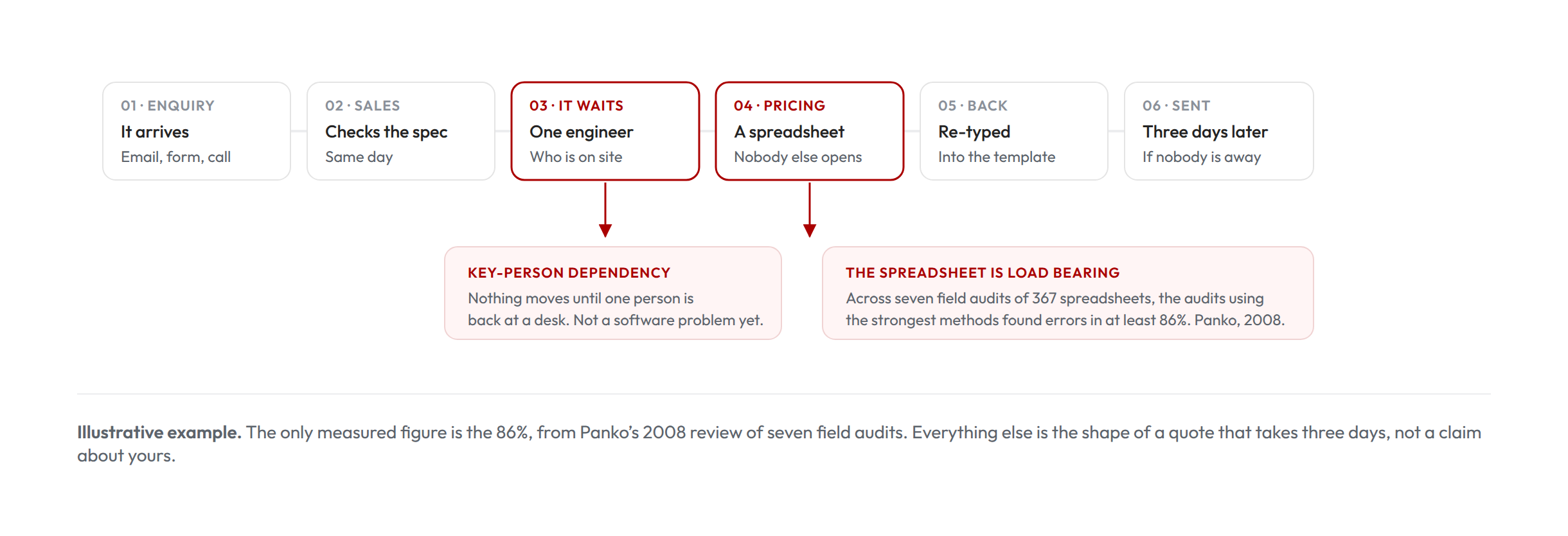
Seven field audits covering 367 spreadsheets found errors in 24% overall, but the audits using the strongest methods found errors in at least 86%. Panko, 2008. The gap is explained entirely by how hard anyone looked.
Where the three days actually go.
Before anything gets built we draw how work moves through the business: who touches an enquiry, what they do to it, and where it waits. The waiting is usually the cost, and it is usually not where people expect.
When custom software is the answer, and when it is not.
Software is the most expensive thing on this site and the easiest to buy for the wrong reason. Here is the honest split.
Worth doing when
- One person is the only one who can complete a step, and everyone knows who.
- The same information gets typed into three systems by hand.
- A spreadsheet decides prices and nobody has ever audited it.
- You have outgrown an off-the-shelf tool in a specific, nameable way.
Worth postponing when
- Nobody has written down how the process actually works today.
- The real problem is that two people disagree about who owns a step.
- An off-the-shelf tool would do it and nobody has tried one.
- The budget assumes the average project rather than the tail.
What actually moves the number.
Four things move the cost of a build, and writing code is only one of them.
What people ask before they commit.
The ones that come up most, answered plainly.
- A written answer, not a sales proposal
- What is wrong, and what to fix first
- Yours whether or not you build with us