Creatif Work
  • Home
  • Services
    • Websites
    • Custom software
    • AI tools
    • Web apps
    • Infrastructure support
    • Brand identity
  • Our Work
  • Blog
Get in touch
Creatif Work
Get in touch
04 · Web apps

A system that lives in a browser and does real work.

  • A web app is not a website with a login bolted on. It is the thing your team, your suppliers or your clients use to get something done, and it is judged on whether the work gets finished, not on how it looks on the first screen.
The constraint

Nobody complains about internal tools. That is the problem.

Internal systems have a captive audience. The people using them cannot go elsewhere, so they work around the problems instead of reporting them, and nothing generates the pressure that makes public-facing software improve.

A decade that did not move

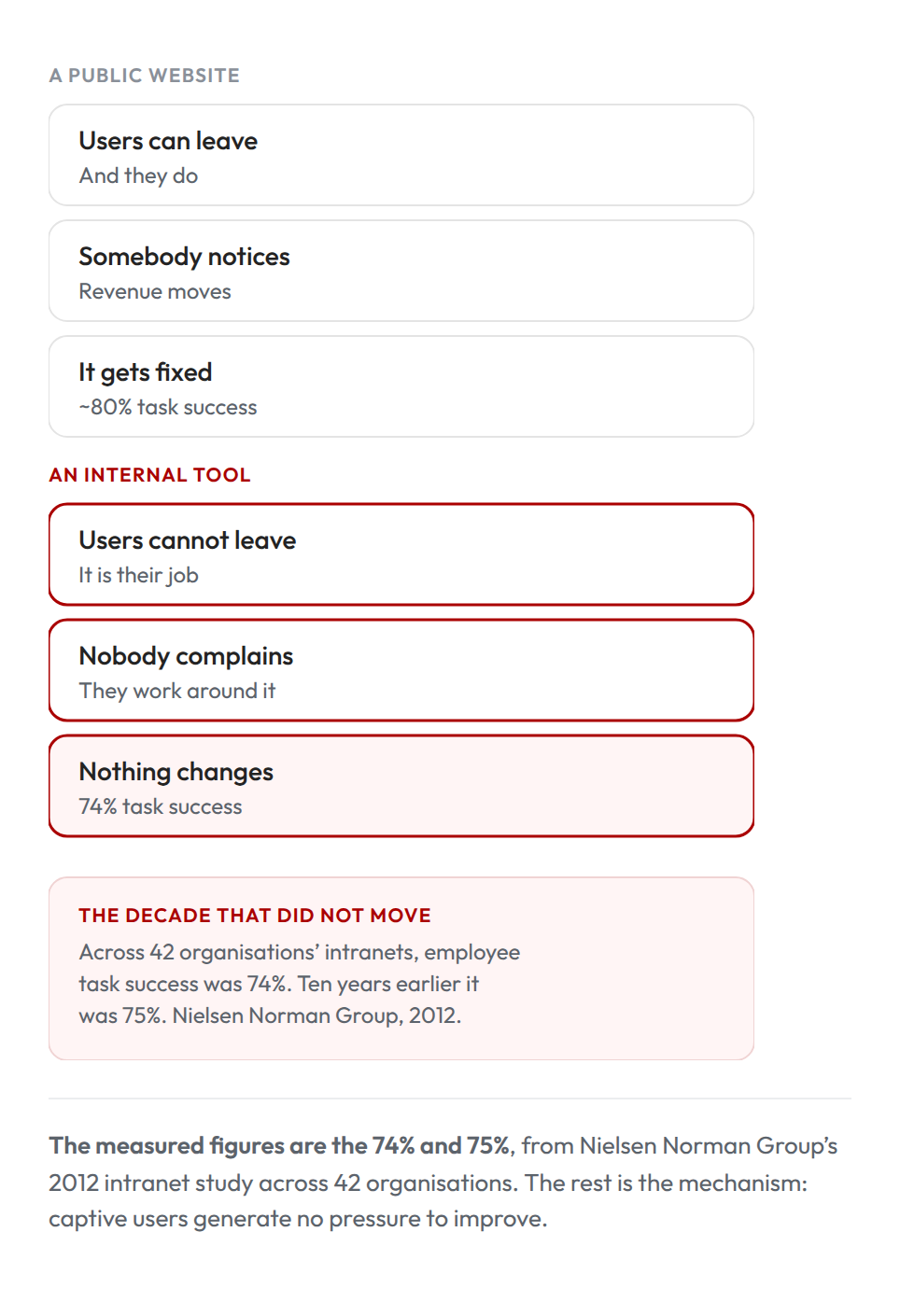
Across 42 organisations’ intranets, employee task success was 74%. Ten years earlier it was 75%, while public websites reached around 80%. Nielsen Norman Group, 2012. The date is the point.

Where the budget already goes

Legacy systems typically consume 70 to 75% of total IT budget and around 80% of total cost of ownership. CISQ, 2022 — an estimate synthesised from 88 sources rather than a measurement, and worth treating as such.

Knowing is not fixing

Even on the flaws organisations worked hardest to patch, only about 54% were fully remediated, at a median of 32 days. Verizon, 2025. A system nobody owns does not get looked after by default.

Sample

Why the internal one never gets better.

The mechanism is not laziness and it is not budget. It is that the feedback loop which fixes a public website does not exist inside a business.
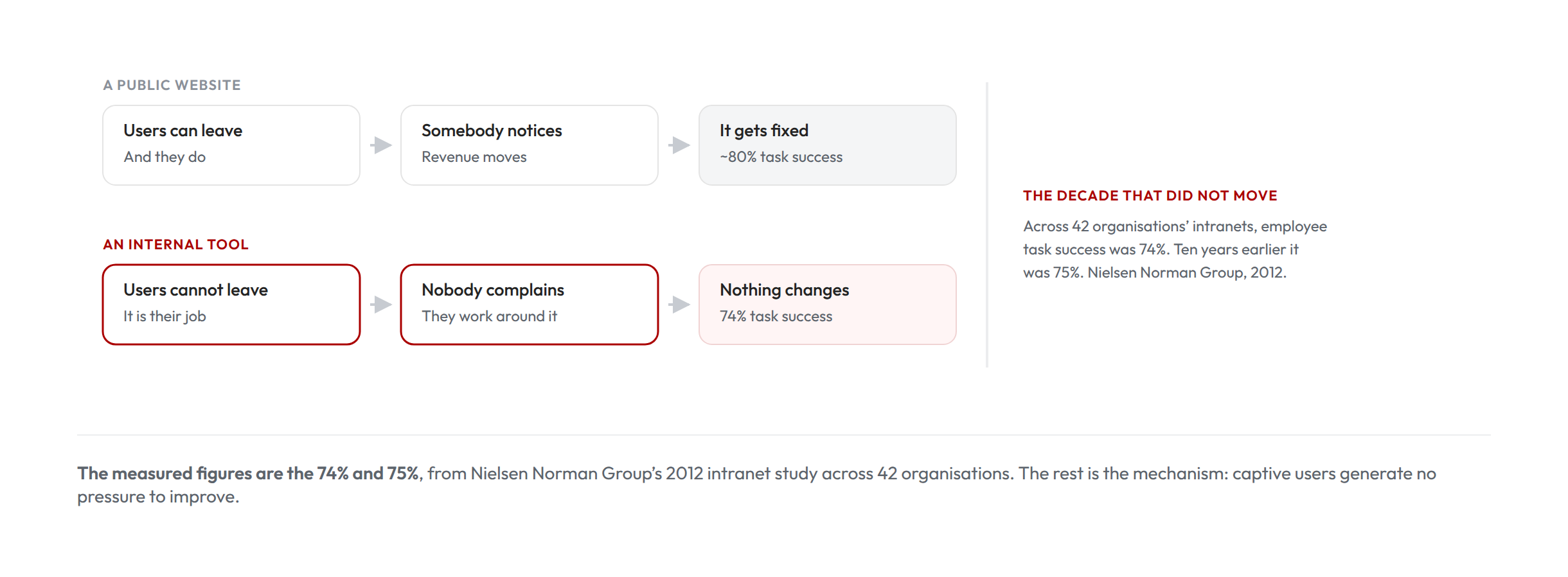
Two tracks comparing a public website, whose users can leave and which reaches about eighty percent task success, with an internal tool, whose users cannot leave and which sits at seventy four percent.
Vertical version of the comparison between a public website that improves because users can leave and an internal tool that does not because they cannot.
Fit

When a web app is the answer, and when it is not.

The test is whether somebody is currently doing work the system will not let them do properly.

Worth doing when

  • People keep a parallel spreadsheet because the system will not do something.
  • Clients or suppliers need to see or submit something and currently email it.
  • The same work is done differently by different people, and both are defensible.
  • It has to work on a phone, on site, with no training.

Worth postponing when

  • Nobody has watched somebody do the task end to end.
  • The request is for a portal, with no first job named.
  • An existing tool does it and the objection is the monthly fee.
  • The people who would use it have not been asked.
Scope

What actually moves the number.

Four things move the cost, and the interface is rarely the biggest of them.

Who logs in, and what each of them may see
One kind of user is a straightforward build. Staff plus clients plus suppliers, each seeing a different slice of the same data, is where the real complexity lives. Permissions are not a feature added later; they shape everything underneath.
Whether it works on a bad connection
A tool used at a desk and a tool used in a yard, a plant room or on a vessel are different engineering problems. If it has to survive losing signal halfway through a form, that needs saying at the start.
What it has to connect to
Reading from an accounting system, writing back to a CRM, or staying in step with a piece of hardware each adds a dependency that changes on somebody else’s schedule.
How much of the old data comes with it
Migrating records entered inconsistently over years is routinely the largest line in the build, and it is the part most often left out of an estimate.
Questions

What people ask before they commit.

The ones that come up most, answered plainly.

How is this different from a website?
A website is read. A web app is used. The measure of a website is whether somebody understood. The measure of an app is whether the task got finished, which means it is judged on task success, error rates and speed rather than on appearance.
Could it just be a spreadsheet?
Often, and for a while it should be. A spreadsheet is the cheapest way to find out what the process really is. It becomes a problem when it is deciding prices, holding data nobody backs up, or when only one person can open it without breaking something.
Who owns it when it is finished?
You do, including the code, the hosting and the accounts. That is set up at the start rather than transferred at the end.
What happens after launch?
Thirty days of support is included, covering bugs, minor edits and questions. Beyond that, an app with real users needs somebody watching it, which is what infrastructure support covers.
Our team is not technical.
Neither are most of the people who use what we build. If it needs training to complete a common task, that is a design failure rather than a user problem, and it is the thing we test for.
Start here
  • A written answer, not a sales proposal
  • What is wrong, and what to fix first
  • Yours whether or not you build with us

Start with a diagnostic.

Tell us what you're dealing with. You get a written answer: what is wrong, what to fix first, and in what order.

Start with a diagnostic
(+65) 8836 4587

We work out how a business actually runs, then build the thing that's missing.

Get in touch

  • +65 8836 4587
  • hi@creatif.work

Find us

LinkedinGoogle

Start with a diagnostic

Tell us what you are dealing with. You get a written answer either way.

Start with a diagnostic

© 2026 Creatif Work. All rights reserved. UEN 53472293L

  • Terms
  • Privacy
Creatif Work
Manage Cookie Consent
To provide the best experiences, we use technologies like cookies to store and/or access device information. Consenting to these technologies will allow us to process data such as browsing behavior or unique IDs on this site. Not consenting or withdrawing consent, may adversely affect certain features and functions.
Functional Always active
The technical storage or access is strictly necessary for the legitimate purpose of enabling the use of a specific service explicitly requested by the subscriber or user, or for the sole purpose of carrying out the transmission of a communication over an electronic communications network.
Preferences
The technical storage or access is necessary for the legitimate purpose of storing preferences that are not requested by the subscriber or user.
Statistics
The technical storage or access that is used exclusively for statistical purposes. The technical storage or access that is used exclusively for anonymous statistical purposes. Without a subpoena, voluntary compliance on the part of your Internet Service Provider, or additional records from a third party, information stored or retrieved for this purpose alone cannot usually be used to identify you.
Marketing
The technical storage or access is required to create user profiles to send advertising, or to track the user on a website or across several websites for similar marketing purposes.
Manage options Manage services Manage {vendor_count} vendors Read more about these purposes
View preferences
{title} {title} {title}
1

WhatsApp us

Navigation

  • Home
  • Services
    • Websites
    • Custom software
    • AI tools
    • Web apps
    • Infrastructure support
    • Brand identity
  • Our Work
  • Blog
Let's talk

Follow Us

Instagram
Facebook
LinkedIn